
Quick Answer
Repair works for chips smaller than a quarter and cracks under about three inches that are not in the driver’s line of sight or at the glass edge. Anything larger, deeper, edge-located, or directly in front of the driver usually calls for full replacement. Damage location matters as much as size.
The repair-or-replace question is one Houston drivers face constantly, because rock chips are an everyday hazard on local freeways. The good news is that the rules are clearer than most people expect once you know what installers actually look at.
The Four Things That Decide It
A trained technician checks four factors before recommending anything. You can check the same ones in your driveway.
- Size: Chips up to roughly a quarter and cracks up to about three inches are usually repairable. Modern resin can sometimes stretch that, but bigger damage trends toward replacement.
- Location: Damage at the outer edge weakens the structural bond and almost always means replacement, since edge cracks spread and undermine the seal.
- Depth and layers: A windshield has two glass layers with a plastic interlayer. Damage that reaches the inner layer cannot be safely repaired.
- Line of sight: Even a perfect repair leaves slight distortion. In the driver’s direct view, that distortion is a hazard, so replacement is preferred.
Why This Matters
 Your windshield is a structural component, not just a window. It supports the roof in a rollover and provides the backstop the passenger airbag pushes against when it deploys. A compromised windshield can mean a roof that crumples more easily and an airbag that does not position correctly.
That is why the repair-or-replace call is a safety decision first and a cost decision second. Treating a spreading edge crack as cosmetic is how a $90 repair window turns into a $500 replacement, or worse, a windshield that fails when you need it most.
How Each Option Actually Works
Understanding the process makes the decision obvious.
- Repair: The technician cleans the chip, injects a clear resin under pressure to fill the void, then cures it with UV light. It restores strength and stops the spread, though a faint mark may remain. A timely windshield repair takes about 30 minutes.
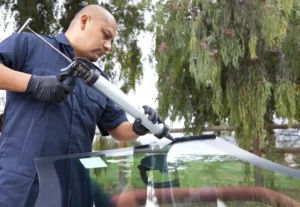
- Replacement: The old glass is cut out, the pinch weld is cleaned and primed, fresh urethane is applied, and new glass is set and allowed to cure. On newer vehicles this is followed by camera recalibration. A full windshield replacement is the only safe answer once damage crosses the thresholds above.
Common Mistakes Drivers Make
- Using a DIY resin kit on the wrong damage: Store kits can work on a fresh, tiny chip, but applied to a crack or contaminated chip they trap air and dirt, making a professional repair impossible afterward.
- Blasting the AC or defroster at a chip: Hitting hot glass with cold air, or cold glass with hot air, creates thermal shock that runs a small chip into a long crack within seconds.
- Ignoring an edge crack: Edge cracks look minor but spread fastest and almost always force a replacement.
- Waiting through the summer: Heat and vibration on rough Houston roads turn repairable chips into replacements faster than people expect.
- Running a car wash over a fresh chip: High-pressure water and brushes can drive grit into the damage and spread it.
Comparison: Repair vs Replacement at a Glance
The two are not competing services. They fit different damage.
- Choose repair when: the damage is small, away from the edge, outside your direct line of sight, and recent. It is faster, far cheaper, keeps your factory seal intact, and is often fully covered by insurance with no deductible.
- Choose replacement when: the crack is long or spreading, sits at the edge, penetrates the inner layer, or blocks your view. It costs more and takes longer, but it is the only option that restores full structural integrity.
What happens if you choose wrong: repairing damage that should have been replaced leaves a weak point that can fail; replacing damage that could have been repaired wastes money and disturbs a factory seal that was working fine.
Why Choose Affordable Auto Glass
- Experience: Technicians who assess damage honestly and tell you when a repair will hold, instead of defaulting to the more expensive job.
- Reliability: Quick turnarounds and mobile service that comes to you, so you can stop a spreading chip before the next hot afternoon makes it worse.
- Quality and technology: Professional resin systems for repairs and proper urethane and calibration for replacements, matched to the actual damage.
- Service area and coverage: Serving drivers across the Greater Houston Area, with same-day options for chips that cannot wait.
Frequently Asked Questions
How big is too big for a repair?
As a rule of thumb, chips larger than a quarter or cracks longer than about three inches move into replacement territory, though location and depth can override size.
Will a repaired chip be invisible?
A good repair restores strength and greatly improves appearance, but a faint blemish often remains. The goal is structural soundness, not a flawless cosmetic finish.
Does a crack in front of the driver always mean replacement?
Almost always. Even a clean repair leaves slight optical distortion that is unacceptable directly in the driver’s view.
Can I drive on a cracked windshield for a while?
You can, but a crack at the edge or in your line of sight is both a safety risk and a likely inspection failure, and Houston heat will keep spreading it.
Is repair covered by insurance?
Many comprehensive policies cover chip repair with little or no deductible, since it is cheaper for the insurer than a future replacement.
How quickly should I act after a rock chip?
As soon as possible. The sooner a chip is sealed, the better it holds and the lower the chance it becomes a replacement.